NATURAL GAS-POWERED ELECTRIC GENERATORS
<------------------------------------------------------------------------------------------------------------------------------------------->
THE BASIC FACTS YOU NEED TO KNOW ABOUT NATURAL GAS
| Home |
| How does it work |
| Home generators |
| Sizing |
| Watt, VA, PF |
| Portable |
| Natural Gas |
| Diesel |
| Gas |
| Propane |
| Wind Power |
| Hydrogen |
| Alternative energy |
Let me first review some basic facts about natural gas (NG). (If you are not interested in these details, go straight to the generator comparison chart and ratings). More than half of the homes in the U.S. use NG for the heating. This makes gaseous-based systems the most common type of standby home generators. Technically speaking, NG is a flammable mixture of hydrocarbon gases, consisting primarily of methane. It is a fossil fuel found in reservoirs underneath the earth. Into US this fuel comes primarily from North America.
The individual customers such as homes or buildings get depressurized NG delivered via small-diameter pipes (0.5-1.5"), called "services". Large industrial, commercial, and electric generation customers sometimes receive pressurized NG directly from interstate pipelines. The household appliances are designed to operate typically at 0.1-0.2 psi and normally include a regulator to drop the incoming line pressure to this level. Natural gas pressure at many homes served by old lines is 0.2-0.3 psi. Newer service lines may operate at 2-50 psi. For these systems, the gas meter includes a regulator that reduces the incoming pressure to 0.2-0.25 psi. Most generators for homes or commercial use are currently designed to work from standard gas pressure 0.18-0.25 psi (5 to 7 inches of water column), so you should not have problem with this. However, occasionally some high power models may need a higher fuel pressure. The other important thing to know about your service is flow capacity of your meter, which is stated on its nameplate- we will discuss it below.
NATURAL GAS GENERATORS FOR HOME USE
The term "generator" in electric industry casually refers to a device containing a combination of an engine with an electric generator head assembled together as a single piece of equipment called genset. The gensets whose engine is fueled by NG typically cost about the same as propane-fueled devices and generally are cheaper than diesels. You can find them for sale at about $200-400 per kilowatt. Normally, permanently installed backup power systems are selected based on the type of the fuel you already use for the heating. Therefore a natural gas generator is an obvious choice of back up power device for the houses connected to an NG line. See our guide to standby generators for home use for more information. Besides private homes, NG gensets are utilized in commercial installations, although for such applications diesels are more common because of their higher reliability.
The main advantage of an NG-powered device is it's hooked up directly to the home's gas line, so you don't have to store any fuel. It can provide emergency power for as long as the fuel is available (except for short breaks for oil change and other required periodic service). See our ebook for detailed step-by-step guide to selection, sizing and connection.
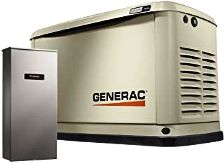
WHAT IS THE BEST NATURAL GAS GENERATOR?
The leading US manufacturers of residential backup power equipment are Generac®, Briggs & Stratton, Cummins® Onan®, and Kohler®. Caterpillar makes primarily large industrial-grade devices. Coleman no longer makes gensets, and the assets of Coleman's Powermate were acquired by a company called PRAMAC. Generac-made standby models are often sold under brand name Guardian®. Guardian® series features probably the broadest selection of automatic systems at the one of lowest costs per kW. They are ranging from 8 to 22 kW for residential air cooled models and 25 to 60 kW for commercial water cooled. As far as I can see, based on the product documentation, Siemens, Eaton and Honeywell brands were private labels made by Generac®. GE and Milbank automatic systems were built and serviced by Briggs & Stratton. Briggs & Stratton by the way, currently operates under chapter 11 bankruptcy protection. Nowadays most manufacturers offer at least 5-year limited warranty. Champion Power Equipment offered 10-year warranty on some models. See the chart below as well as our home generators review for the comparative ratings of top brands. Note that most manufacturers do not include a starting battery, which you have to buy separately. Also note that many residential NG models are usually bi-fuel: they can also run on propane after a simple DYI adjustment. Such models are usually advertised by their propane wattage, which may be slightly higher. Our rating chart below provides the wattage numbers for NG, which are always lower.
| Model | Make | Watts on NG | Case |
| 7228 | Generac® | 18 kW | aluminium |
| 40555 | Briggs & Stratton | 14.4 kW | galvanneal steel |
| 14RCAL-200SELS | Kohler® | 12 kW | composite |
| 100179 | Champion | 12.5 kW | steel |
NG gensets are available online, from the dealers and from hardware stores. You can often buy online for less, you will just need to find a professional installer. Alternatively, if you prefer, you may work with a local contractor, who will do both delivery and installation, but then he will likely add markup to the generator cost.

INSTALLATION BASICS
The manufacturer's manuals of course contain detailed installation requirements. However, it's worth to know the basic details in advance. First of all check the capacity of your existing gas meter. In many homes it could be 250 cubic feet per hour or less (1 CFH≈1000 BTU/h). This is not enough to run large devices rated 14 kW or greater. Check with your utility company the cost of changing the meter for a higher volume one. If it turns out to be too expensive, you may have to choose a smaller genset. Also note that you can't connect any power source directly to the house wiring. Electrical connection to the wiring system must be done via a special transfer switch, which is usually included in the automatic systems. All generators must be operated outdoors only, but most transfer switches are indoor rated. The installation and all the connections of course are supposed to be done by qualified professionals. You should consult local fuel suppliers or the fire department to check the codes and regulations, and insist your installer follow them. For example, local codes may mandate a specific routing of gas line piping. Generally, the system should be located as close as possible to both the fuel supply and to the main electrical service panel. The exhaust should be kept away from windows and doors with at least 10 feet clearance according to NFPA 37.
You should place the generator on high ground where water levels will not rise and endanger it. Mount it on a level surface and allow sufficient room on all sides for servicing. A genset is typically placed on pea gravel or crushed stone. Check local codes if a concrete base slab is required.
The pipe sizing, construction and layout must comply with NFPA 54 and local codes. Here are some basic rules. At least one manual shut-off valve must be installed in the gaseous fuel supply line. The fuel connection should be made by a licensed plumber. Make sure he uses AGA approved pipes and a proper pipe sealant or joint compound. Remember that natural gas is highly explosive. Even the slightest spark can ignite it and cause an explosion. All installed gaseous fuel piping must be purged and leak tested prior to initial start-up in accordance with applicable standards and regulations. Note that natural gas, which is lighter than air, tends to collect in high areas if it leaks. When connecting the gas line to the generator use the flexible fuel line to ensure that vibration will not cause a leak at the connection points. Do not bend the flexible fuel line beyond 10 degrees. Where the fuel enters the generator, install a T-fitting to allow for the pressure monitoring. Once the system is installed, verify that the fuel pressure does not drop below the required minimum, which is typically 5 inches WC or 0.18psi.
All trademarks, trade names and service names are property of their respective owners.
<------------------------------------------------------------------------------------------------------------------------------------->