HOME GENERATORS |
|||||||||||||||
<----------------------------------------------------------------------------------------------------------------------------> |
|||||||||||||||
Our everyday life depends on the continuous flow of electricity probably more than we realize. A few hours without power may be just an inconvenience, but losing it for days or even weeks of course can be costly and life threatening. 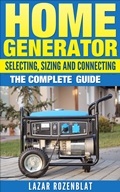
AVAILABLE TYPES |
|
||||||||||||||
You probably know already that there are two basic types of home generators: stationary and portable. They are often called gensets because they are actually the sets comprising of an alternator and an engine.
I am going to emphasize all the advantages as well as drawbacks and the issues associated with each of these types. Before going over the details, let's start with a quick background information for those who are new to this subject.
 Then after a short warm up period you can connect it to your equipment. There are no auto start portables. Gasoline and diesel models come with an on-board fuel tank; propane and natural gas models have to be connected to an external tank or fuel line. A big disadvantage of the devices with an on-board tank is they have to be refueled several times a day if you load them to their maximum capacity. This is something you won't be able to do if gas stations don't work. That's why if you decided to go for a portable one I recommend to consider propane or dual-fuel models.
Note that all engine-driven units must be run only outdoors. A stationary device always sits outside just like a central a/c. A portable one is normally stored elsewhere and rolled out only when you need to use it. There are detailed descriptions and reviews of different generators in our SMPS site. Here we will just discuss the basics.
As you realize, all types of gensets have pros and cons. Fixed systems provide the highest level of comfort, but of course it comes with a price tag. Depending on wattage and options, complete systems with a transfer switch may sell for $3000 to $6000. You will also need to spend five to ten thousand dollars for electrical wiring and fuel hook up. Before the installation, your installer will need to obtain permits from your utilities and pass the inspections after the work is done. All this, obviously, takes time. So, if you are looking for an emergency generator because there is a hurricane or an ice storm in tomorrow's forecast, it is too late to consider a standby type. Another issue is service. A hard-wired appliance that weights 400-500 pounds is not something you can easily disconnect and ship back or bring to a repair shop. Should you need a repair, you'll have to wait for a service technician to come to your place or for the manufacturer to send you a replacement part.
Portable generators are much cheaper-- their prices start at around $200 for a 1000W model. Unlike stationary devices, they don't have to be hardwired to your house unless you choose to. Their control panel has several outlets of various types into which you can plug cables from your electric loads. This can be both an advantage and a disadvantage. On one hand, you can start using such device, so to speak, right out of the box. However, this would work only if you want to run "cord and plug" appliances, such as refrigerators and window air conditioners. You can just unplug them from the wall outlets and connect via extension cords to the generator. However, when it comes to lights, furnaces and everything else that is wired directly into your house electrical lines, you'll face problems powering them up. This is something homeowners often don't realize while dealers may neglect to mention to you.
You might ask, why can't I just plug my genset into a wall outlet? Well, technically it is possible, but you would need to overcome a number of hurdles.
First of all, it is illegal and dangerous to connect any voltage source into any electrical wiring connected to the grid. By trying to energize your house without isolating it from the outside you are feeding voltage back into the utility lines. This may hurt line workers or your neighbors who may think the mains is down. Aside from this, unless you are the only one who lost power, you would actually be trying to power up all the neighbors houses who lost electricity. This would immediately overload your generator and trip its circuit breaker. So, you would need first to isolate your house wiring from the grid by flipping the main circuit breaker on the service panel to OFF position. It's not so safe though because it leaves a possibility of a human error.
Secondly, remember that a standard wall outlet is rated for 15A. So, you can't use it for more than 120x15=1800 volt-amps. If you draw a higher current you may overheat the socket and the wires, which is a fire hazard.
That's why if you want to run your built-in appliances and lights from a portable source you need some sort of a redundant switch. In this case it has to be a manual one though. Such a connection via a switch is the safest one, but you would still have to deal with the professional installation, permits, inspections, etc. Still, a portable device may not be able to run your entire house. You need to turn off some circuit breakers leaving only lines your device is able to run.
Transfer switch addresses safety issue, but will create hurdle to overcome if you buy a portable model equipped with GFCI and grounded neutral. In such a model the GFCI will trip when you use it with a regular transfer switch. This is something the manufacturers and retailers may not always mention you. So, if you got a genset with GFCI you need to buy a special 3-pole transfer switch or otherwise disconnect its ground wire. In any case, a setup with a transfer equipment is still cheaper than a stationary one for two reasons: because portables cost less than standbys and because manual switches cost less than automatic ones.
In case of emergency, if you have no choice and you really need to connect your genset into a wall outlet, see portable generator connection for more details and wiring diagrams. This is not a recommended method though unless it's a real emergency.
Well, buying the right model for the home involves several key decisions:
How much power do you need?
How soon do you need to use it?
How often do you expect to use it and for what duration of time?
Are you able to move around a few hundred pound device?
Here is when you definitely need a standby home generator system:
For standby gensets, my pick is the Generac Guardian® series available in the range from 8 kW and 45 kW. For my advice on portables, see my picks of best portable generators for home.
Whatever genset you choose, remember that all engine driven devices have a common disadvantage- they all require maintenance, such as frequent oil changes. If you don't feel like getting involved into this, you may want to consider a maintenance-free battery backup solution. More details are provided in my review of different types of power generators, which compares traditional and alternative power systems. If you are interested in "green" energy, check out the tutorials on residential wind generator and to solar-powered system.
Stationary
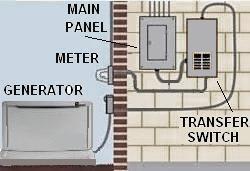
(standby) systems are permanently connected to your house and hooked up to a fuel source. Normally this would be the same source you use for the heating: natural gas, propane or diesel. An indoor transfer panel isolates home wiring from input lines during utility power failure (see simplified connection diagram). The wattage of the available air cooled standby systems intended for home use ranges from 6 kilowatt to 20 kW, so you need to figure out the right power level that can supply the whole house including central a/c, sump pump, etc. In automatic mode such a system will start by itself without your involvement when it detects a power interruption. Likewise it will shut down when utility voltage is restored.Portable
devices range from 500 W to almost 20,000 W. When you need to use a portable genset, you have to move it to the place where you want to use it, fill with fuel and start up.
Then after a short warm up period you can connect it to your equipment. There are no auto start portables. Gasoline and diesel models come with an on-board fuel tank; propane and natural gas models have to be connected to an external tank or fuel line. A big disadvantage of the devices with an on-board tank is they have to be refueled several times a day if you load them to their maximum capacity. This is something you won't be able to do if gas stations don't work. That's why if you decided to go for a portable one I recommend to consider propane or dual-fuel models.Note that all engine-driven units must be run only outdoors. A stationary device always sits outside just like a central a/c. A portable one is normally stored elsewhere and rolled out only when you need to use it. There are detailed descriptions and reviews of different generators in our SMPS site. Here we will just discuss the basics.
PROS AND CONS OF DIFFERENT TYPES
As you realize, all types of gensets have pros and cons. Fixed systems provide the highest level of comfort, but of course it comes with a price tag. Depending on wattage and options, complete systems with a transfer switch may sell for $3000 to $6000. You will also need to spend five to ten thousand dollars for electrical wiring and fuel hook up. Before the installation, your installer will need to obtain permits from your utilities and pass the inspections after the work is done. All this, obviously, takes time. So, if you are looking for an emergency generator because there is a hurricane or an ice storm in tomorrow's forecast, it is too late to consider a standby type. Another issue is service. A hard-wired appliance that weights 400-500 pounds is not something you can easily disconnect and ship back or bring to a repair shop. Should you need a repair, you'll have to wait for a service technician to come to your place or for the manufacturer to send you a replacement part.
You might ask, why can't I just plug my genset into a wall outlet? Well, technically it is possible, but you would need to overcome a number of hurdles.
First of all, it is illegal and dangerous to connect any voltage source into any electrical wiring connected to the grid. By trying to energize your house without isolating it from the outside you are feeding voltage back into the utility lines. This may hurt line workers or your neighbors who may think the mains is down. Aside from this, unless you are the only one who lost power, you would actually be trying to power up all the neighbors houses who lost electricity. This would immediately overload your generator and trip its circuit breaker. So, you would need first to isolate your house wiring from the grid by flipping the main circuit breaker on the service panel to OFF position. It's not so safe though because it leaves a possibility of a human error.
Secondly, remember that a standard wall outlet is rated for 15A. So, you can't use it for more than 120x15=1800 volt-amps. If you draw a higher current you may overheat the socket and the wires, which is a fire hazard.
That's why if you want to run your built-in appliances and lights from a portable source you need some sort of a redundant switch. In this case it has to be a manual one though. Such a connection via a switch is the safest one, but you would still have to deal with the professional installation, permits, inspections, etc. Still, a portable device may not be able to run your entire house. You need to turn off some circuit breakers leaving only lines your device is able to run.
Transfer switch addresses safety issue, but will create hurdle to overcome if you buy a portable model equipped with GFCI and grounded neutral. In such a model the GFCI will trip when you use it with a regular transfer switch. This is something the manufacturers and retailers may not always mention you. So, if you got a genset with GFCI you need to buy a special 3-pole transfer switch or otherwise disconnect its ground wire. In any case, a setup with a transfer equipment is still cheaper than a stationary one for two reasons: because portables cost less than standbys and because manual switches cost less than automatic ones.
In case of emergency, if you have no choice and you really need to connect your genset into a wall outlet, see portable generator connection for more details and wiring diagrams. This is not a recommended method though unless it's a real emergency.
WHAT GENERATOR DO I NEED?
Well, buying the right model for the home involves several key decisions:
How much power do you need?
How soon do you need to use it?
How often do you expect to use it and for what duration of time?
Are you able to move around a few hundred pound device?
Here is when you definitely need a standby home generator system:
- Your house requires more than 17 kW power, or
- You want to be prepared for long-term power outages, or
- You want fully automatic operation, or
- You don't want to move around a heavy device.
- You need emergency power immediately;
- You are looking to spend less than $1,500 (maybe even a few hundred dollars).
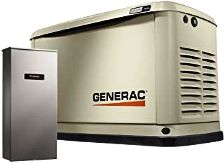
For standby gensets, my pick is the Generac Guardian® series available in the range from 8 kW and 45 kW. For my advice on portables, see my picks of best portable generators for home.
Whatever genset you choose, remember that all engine driven devices have a common disadvantage- they all require maintenance, such as frequent oil changes. If you don't feel like getting involved into this, you may want to consider a maintenance-free battery backup solution. More details are provided in my review of different types of power generators, which compares traditional and alternative power systems. If you are interested in "green" energy, check out the tutorials on residential wind generator and to solar-powered system.
<-------------------------------------------------------------------------------------------------------------------->